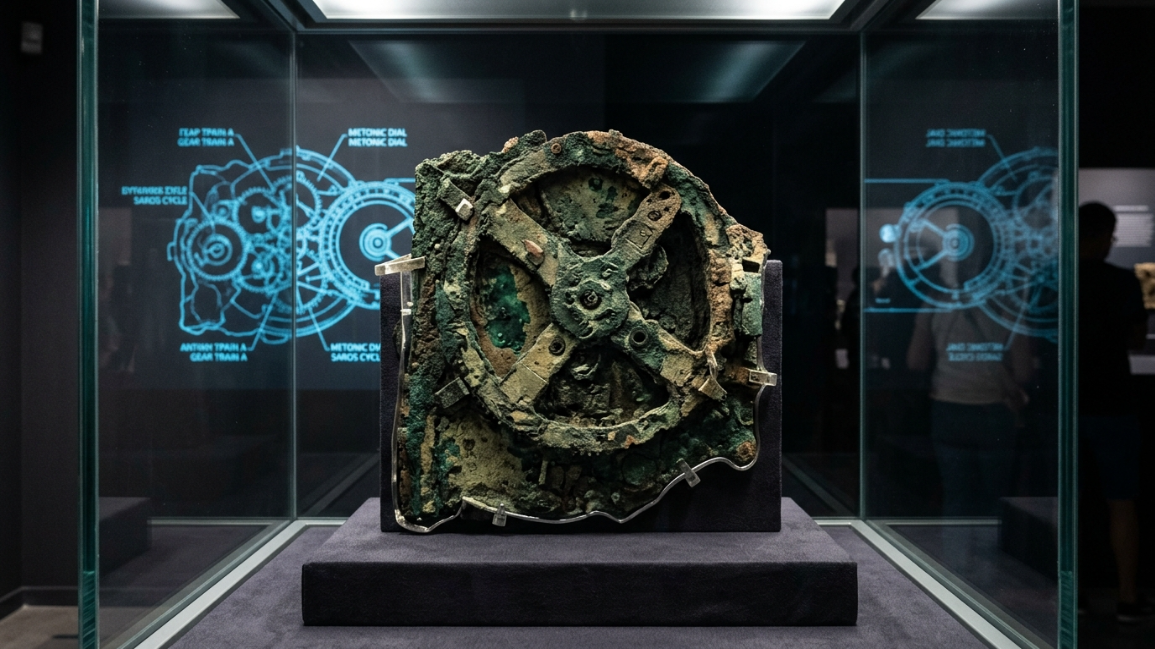
Recovered by sponge divers in 1901 from a Roman-era shipwreck near the Greek island of Antikythera, a heavily corroded lump of bronze initially dismissed as a simple fragment of statuary has fundamentally forced the rewrite of human technological history. Dating back to roughly 150 BC, the Antikythera mechanism is not a crude astrological trinket; it is the world’s oldest known analog computer. Built centuries before the emergence of comparable clockwork devices in medieval Europe, this complex artifact features dozens of interlocking, precision-cut bronze gears designed to track planetary movements, lunar phases, and eclipse cycles with absolute mathematical accuracy. For decades, its advanced design was used to promote claims of ancient anomalies or lost timelines. Today, cross-sectional X-ray tomography and micro-focus industrial imaging have shattered these speculations. A rigorous Antikythera mechanism mechanical engineering reconstruction exposes a highly advanced, deeply logical tradition of Hellenistic mathematical engineering.
What makes this ancient device an exceptional focus for contemporary mechanical study is the astonishing precision of its gear ratios. By moving past surface-level folklore and examining the physics of the differential gear train, the layout of the lunar anomaly pin-and-slot mechanism, and the math behind its 30-tooth gear teeth, mechanical engineers are reconstructing the exact internal blueprints of this ancient computer.
1. The Physics of the Epicyclic and Differential Gear Train
The primary breakthrough in understanding the inner workings of the device arrived when researchers utilized three-dimensional X-ray computed tomography to peer through the thick layers of marine calcification and bronze corrosion. The scans exposed a highly complex, internal gear core consisting of at least 30 separate, interlocking bronze wheels.
What shocked mechanical engineers was the presence of epicyclic gearing—often called planetary gearing—where one gear rotates around another while also spinning on its own axis.
The engineers used this setup to calculate complex astronomical cycles, most notably the Metonic cycle, which tracks the 19-year relationship between the sun and the moon. This differential gear train allowed the device to simultaneously add or subtract different rotational speeds, outputting multiple complex astronomical positions onto separate front and back dials using a single main drive crank. This level of mechanical calculation matches the exact design logic we see in our Derinkuyu underground city engineering analysis, where complex natural cycles were solved using smart, structural geometry.
2. The Micro-Engineered Pin-and-Slot Lunar Anomaly Drive
To modern observers, the moon appears to orbit the Earth at a completely constant, uniform speed. However, ancient Greek astronomers knew this wasn’t the case. Due to the moon’s elliptical orbit, it appears to speed up and slow down throughout the month—a phenomenon known as the first lunar anomaly.
To mimic this variable cosmic speed using rigid, uniform bronze gears, the ancient engineers designed a mind-bogglingly advanced mechanism: the pin-and-slot drive.
The reconstruction shows that two gears were mounted slightly off-center from one another. One gear featured a tiny, protruding pin that slipped into a narrow, elongated slot cut into the face of the second gear. As the primary gear rotated at a completely uniform speed, the pin slid back and forth within the slot, driving the second gear at a variable, constantly shifting speed. This brilliant mechanical translation perfectly mirrored the moon’s elliptical acceleration and deceleration, showcasing a level of micro-engineering that historians previously assumed did not exist until the Renaissance.
📊 Gear Train Metrics and Reconstruction Dynamics
| Mechanical Component | Internal Design Discovered | Core Computational Function | Engineering Advantage |
| Main Drive Wheel | Large central bronze gear connected to a manual hand crank | Inputs the primary rotational force into the analog computer | Powers multiple independent gear trains simultaneously |
| Pin-and-Slot Drive | Two off-center overlapping gears connected by a sliding pin | Generates variable rotational velocity from uniform input | Recreates the elliptical acceleration and deceleration of the moon |
| Metonic Spiral Dial | 5-turn spiral track housing a sliding pointer pin | Tracks the 235-month relationship between solar and lunar years | Eliminates reading errors across long-term multi-decade cycles |
3. The 30-Degree Triangular Gear Tooth Geometry
For a mechanical computer to output accurate astronomical predictions, the individual gear teeth must mesh together with minimal friction and zero slipping. If the teeth are cut unevenly, the gears will jam, destroying the delicate internal alignment.
An intensive Antikythera mechanism mechanical engineering reconstruction focused heavily on the physical shape of the remaining gear teeth. The microscopic analysis revealed that the teeth were not cut square or round; they were carved into uniform, equilateral triangles with a fixed 30-degree pitch.
The builders hand-divided and cut each individual tooth into the bronze sheets using fine metal saws and files. Despite being executed entirely by hand, the dimensional variations between the teeth are incredibly small, measuring in fractions of a millimeter. This extreme consistency ensures that as the main crank is turned, the rotational force flows smoothly through the entire gear train without slipping, showcasing a highly standardized manufacturing process that matches the precision of the Puma Punku stone blocks engineering systems found in the Americas.
4. The 223-Month Saros Eclipse Prediction Matrix
On the back face of the mechanism, the engineering team reconstructed a massive, five-turn spiral dial known as the Saros indicator. This dial was designed to predict the exact month, day, and hour of solar and lunar eclipses across a continuous 18-year cycle.
The gear train driving this dial had to solve a complex mathematical fraction: a ratio of 223 lunar months. To achieve this, the builders constructed a highly specific gear train utilizing an 11-tooth gear meshing with a massive, 223-tooth wheel.
As the pointer traveled along the spiral track, it didn’t just point to a number; it passed over intricate symbols carved into the bronze face. These inscriptions told the user whether an upcoming eclipse would occur during the day or night, what color the moon would turn during a lunar shadow, and what direction the shadow would cross. This complex calculations layout effectively compressed centuries of astronomical observations into a portable, hand-held bronze box, turning raw data into an interactive visual display.
5. Corrosive Taphonomy and the Missing Wooden Housing
The final phase of a complete forensic reconstruction involves evaluating the preservation context of the artifact. When recovered from the seafloor, the mechanism was a fragmented, heavily oxidized mass, mixed with sea sediment and corrosion products.
This condition is the result of over two thousand years of marine taphonomy. The device was originally enclosed within a tight, protective box carved from Mediterranean cedar or walnut wood, featuring multiple hinged doors covered in thousands of characters of explanatory text.
As the wooden outer shell rotted away in the saltwater, the internal bronze plates collapsed under the immense pressure of the deep ocean currents, fusing the shifting gears together into a single, compact lump. The complete lack of other mechanical computing devices in the archaeological record is not proof that the Antikythera mechanism was an isolated freak anomaly. Instead, it highlights a dark historical reality: because bronze was an incredibly valuable metal in the ancient world, older or broken gear systems were systematically melted down and recycled into weapons or coins, leaving this single shipwreck sample as a lone survivor of a lost golden age of mechanics.
The Logistical Verdict on the Hellenistic Computer
The intricate gears of the Antikythera mechanism stand as an undeniable monument to ancient human intelligence. As this Antikythera mechanism mechanical engineering reconstruction proves, this device was not the product of supernatural intervention, but the pinnacle of classic Greek geometry and metalworking.
By using planetary gear trains to add speeds, pin-and-slot configurations to track elliptical orbits, and precise 30-degree gear teeth to prevent slipping, the ancient builders constructed a flawless analog computer. The device proves that the engineers of the ancient Mediterranean had fully mastered the core laws of mechanics and materials, matching the incredible design care we see in other ancient puzzles like the Maltese megalithic temples. The Antikythera mechanism remains a timeless reminder that our ancestors were far more technologically advanced than history books often admit, completely changing our view of the ancient world.
🔍 High-Authority External Context Verification
-
To explore the complete digital scans, X-ray tomography data, and gear train models of the original artifact, visit the Antikythera Mechanism Research Project Repository.
-
For an in-depth breakdown of Hellenistic mathematics and ancient mechanical computing lineages, review the National Archaeological Museum of Athens Collections.