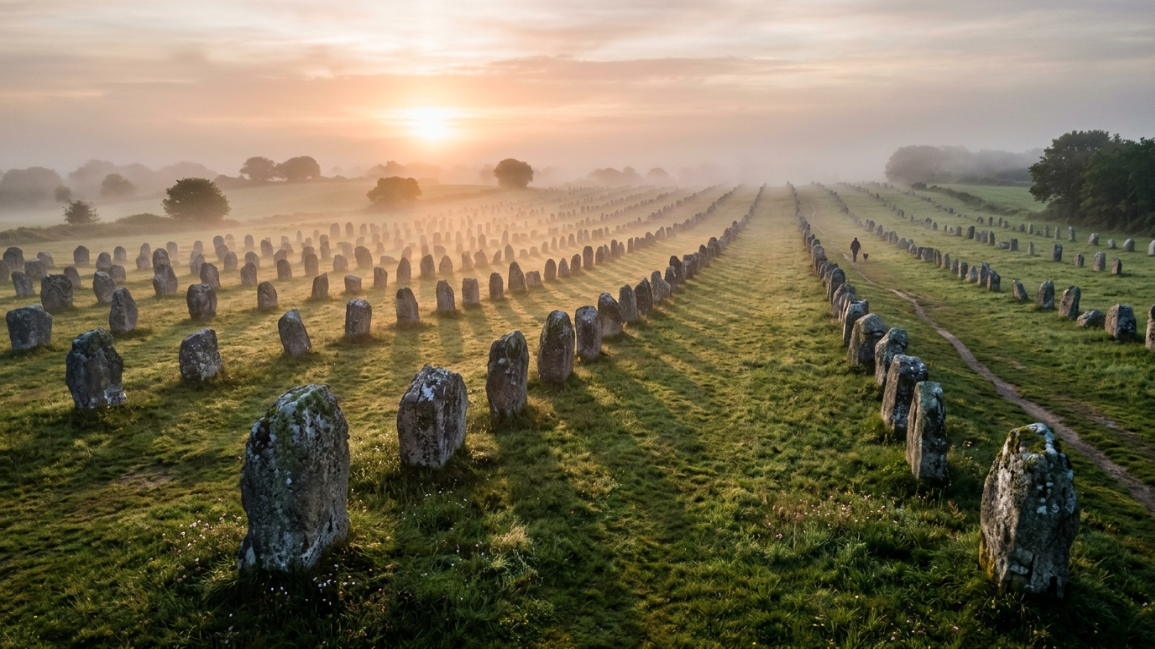
Stretching across miles of the rugged, heather-covered landscape of Brittany, France, lies the largest collection of deliberate megalithic monuments on the face of the earth. Erected by a highly organized, Neolithic society between 4500 BC and 3300 BC, the Carnac site consists of more than 3,000 massive granite stones standing in a series of perfectly straight, parallel lines. These upright monoliths—known as menhirs—range in size from waist-high blocks to towering giants weighing over 20 metric tons. For generations, local folklore claimed these rows were a Roman legion turned to stone by a wizard, while early alternative accounts argued they served as a prehistoric alien landing strip. Today, a thorough structural audit of the Carnac stones alignment has swept aside these myths. By analyzing the site through landscape archaeology and geological survey data, researchers are uncovering an incredible masterclass in deep-time territorial engineering and astronomical surveying.
What makes this Neolithic landscape an exceptional focus for prehistoric engineering study is the absolute scale of its geometric planning. By looking past romanticized myths and examining the physics of mechanical leverage, the layout of the parallel avenues, and the orientation of terminal stone circles, researchers are unravelling the true purpose behind the Carnac stones alignment matrix.
1. The Physics of the Orthogonal Parallel Avenues
The primary diagnostic feature that defines the Carnac stones alignment is its highly disciplined spatial organization. The site is split into distinct, organized groups—such as Le Menec and Kermario—where hundreds of upright stones stand in up to twelve perfectly parallel rows.
These rows do not curve or wander randomly across the landscape; they form straight, uniform corridors that stretch across the countryside for over half a mile at a time.
Using horizon sighting markers to lay out straight geometric paths across hills.
Maintaining this straight line across rolling hills, dips, and changing terrain required advanced surveying methods. Neolithic builders likely used a system of horizon sighting stakes to map out the paths before bringing any stone to the site. This long-distance layout layout matches the advanced geometric care we see in our Pavlopetri sunken city urban grids, proving that prehistoric communities possessed sophisticated techniques to organize large physical spaces.
2. Solstice Tracking and Horizon Archaeoastronomy
A detailed architectural audit of the Carnac stones alignment outlines that these stone avenues were built to function as a massive, open-air astronomical observatory. The lines are not oriented randomly; they follow a specific, calculated compass heading.
The long avenues point directly toward the exact points on the horizon where the sun rises and sets during the summer and winter solstices.
As the sun breaks over the Brittany hills on the longest day of the year, its light streams cleanly down the narrow corridors formed by the granite rows, lighting up specific, extra-large marker menhirs at the end of the line. This setup allowed the prehistoric society to track changing seasons and predict critical agricultural windows with total accuracy. This functional use of landscape geometry to follow cosmic cycles mirrors the design logic uncovered in our secrets-maltese-megalithic-temples guide, where ancient stone walls were built around changing solar paths.
📊 Structural Properties of the Brittany Megalithic Grid
| Engineering Vector | Physical Infrastructure Discovered | Core Operational Function | Impact on the Carnac stones alignment |
| Menhir Corridors | 3,000+ granite stones standing in 12 parallel rows | Funnels solar light paths along straight sightlines | Creates a functional long-distance solstice tracking system |
| Terminal Cromlechs | Semicircular stone circles built at the ends of avenues | Functions as a central ritual gathering and viewing hub | Seals off the ceremonial pathways from the surrounding area |
| Foundation Pits | Deep dirt sockets packed with clay and small river stones | Absorbs seismic ground shifts and heavy soil movement | Prevents the 20-ton stones from tilting or falling over |
3. Localized Granite Sourcing and Mechanical Leverage Logistics
To modern observers, moving thousands of multi-ton blocks across miles seems like an impossible task for a society without iron tools or draft animals. However, a close look at the Carnac stones alignment proves that the builders used smart material logistics to minimize hard labor.
Geological tests show that the stones were not hauled from distant mountain ranges; they were harvested from local surface granite ledges located just a few hundred meters from the lines.
Neolithic workers chose pieces of granite that had already been split and loosened by natural winter freezing. Once a stone was detached, the team used basic wooden levers, braided leather ropes, and heavy oak logs to roll the massive blocks into position. By using simple laws of mechanical leverage, a small, organized group of workers could easily move and raise stones weighing up to 20 tons, turning a daunting task into a manageable construction routine.
4. The Engineering of Terminal Cromlechs and Enclosure Geometry
At the western end of the main Carnac stones alignment groups sit the ruins of massive, semicircular stone enclosures known as cromlechs. These structures are built using stones placed tightly together to form a private, circular arena.
These circular enclosures were built to act as the focal point for the entire site layout.
The parallel avenues gradually widen as they approach these circles, funneling foot traffic directly toward the entrances of the enclosures. The layout reveals that the site was planned as a highly structured, ceremonial pathway. Participants would walk down the long, solar-aligned stone corridors before entering the circular stone arenas for seasonal events, showing that these early builders fully understood how to use architecture to guide human movement.
5. Taphonomic Foundation Packing and Seismic Survival
The final proof of the advanced engineering behind the Carnac stones alignment is its incredible survival. Despite sitting exposed to heavy Atlantic storms, seasonal freezing, and centuries of soil movement, the vast majority of these stones are still standing straight today.
This long-term stability is due to a clever foundation design built into the base of each menhir.
When Neolithic workers raised a stone, they did not simply balance it on the surface soil. They dug a deep socket straight down into the subsoil, dropped the base of the stone inside, and packed the open space with a mixture of dense clay, charcoal, and small river stones. This custom packing mix creates a tough, flexible anchor that absorbs ground movement and minor earth tremors without cracking, ensuring the monoliths remain standing for over 6,000 years.
The Logistical Verdict on the French Monoliths
The impressive avenues of Brittany stand as an undeniable monument to prehistoric intelligence, spatial engineering, and astronomical planning. As this investigation into the Carnac stones alignment proves, the site does not require alternative history legends or lost timelines to explain its existence.
Instead, it is an authentic, beautifully preserved Neolithic landscape feature designed to track solar cycles and organize tribal territory through smart geometry and mechanical leverage. By studying the real facts of local material logistics, horizon astronomy, and foundation packing, modern science has explained how early societies transformed their landscapes. The site remains a timeless reminder of human innovation, matching the incredible preservation we see in other historical mysteries like the secrets-maltese-megalithic-temples.
🔍 High-Authority Academic Context Verification
-
To explore the complete digital mapping surveys and excavations of the Brittany menhir lines, visit the French Ministry of Culture’s Archaeological Database (Mérimée).
-
For an exhaustive look at Neolithic archaeoastronomy and landscape geometry across Western Europe, consult the Bournemouth University Megalithic Research Archive.