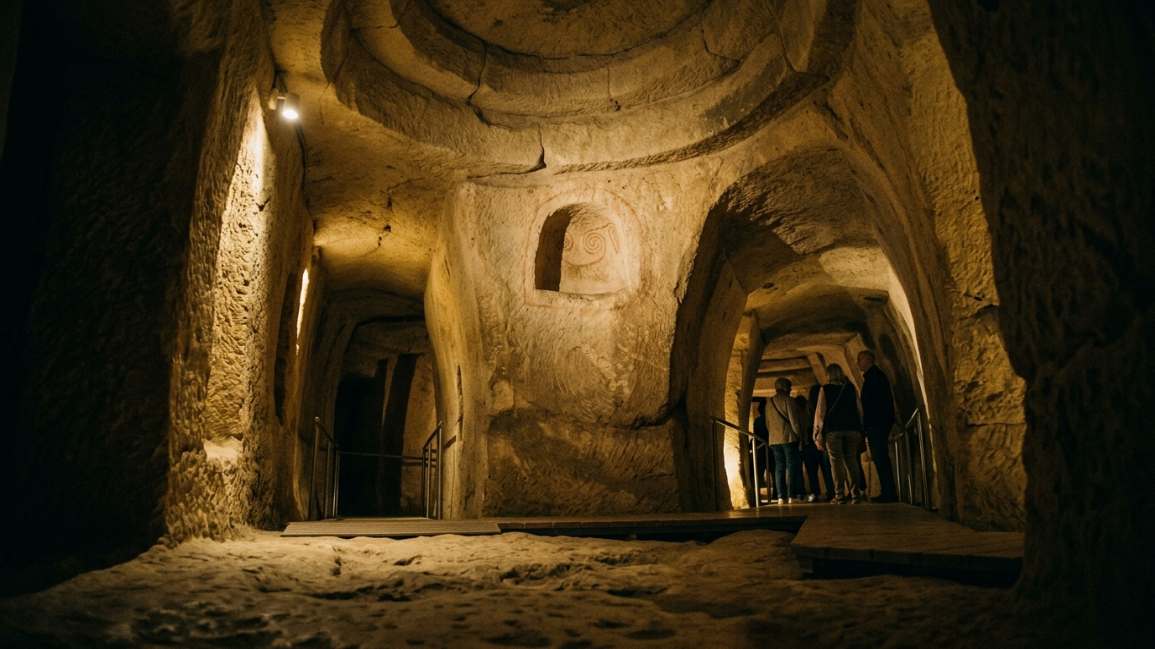
Carved entirely into solid limestone bedrock around 3300 BC on the island of Malta, a massive three-tiered underground sanctuary stands as one of the oldest and most mysterious structural marvels in human history. Discovered accidentally by construction workers in 1902, the Hal Saflieni Hypogeum is a sprawling underground labyrinth containing a complex network of halls, tombs, and ritual rooms. While traditional archaeology heavily tracks the thousands of prehistoric remains recovered from its depths, a rigorous study of the Hal Saflieni Hypogeum acoustics reveals an astonishingly advanced understanding of sound mechanics, wave resonance, and structural design. Built thousands of years before the development of modern audio engineering, this dark stone sanctuary was intentionally carved to alter sound waves and manipulate human consciousness.
What makes this multi-level underground complex an exceptional focus for contemporary research is how its carved limestone surfaces interact with specific vocal pitches. By looking past surface-level folklore and focusing on the physics of the 110 Hz resonance frequency, the layout of the Oracle Chamber niche, and the mechanics of bone conduction, acoustic engineers are unravelling the true purpose behind the Hal Saflieni Hypogeum acoustics matrix.
1. The 110 Hz Acoustic Resonance Frequency Threshold
The primary breakthrough in decoding the Hal Saflieni Hypogeum acoustics arrived when an international team of audio engineers brought specialized acoustic equipment down into the third-tier chambers. They discovered that the curved, womb-like rooms do not reflect sound randomly; they act as a massive, natural resonator tuned to a highly specific frequency.
The solid stone walls are acoustically calibrated to vibrate and amplify sound waves at exactly 110 Hertz.
When a deep male voice chants or speaks within this specific frequency range, the entire stone room enters a state of acoustic resonance. The sound waves bounce off the smooth limestone surfaces and amplify themselves, creating a deep, rumbling drone that fills the entire underground space. This highly calculated, automated natural vibration mirrors the extreme environmental stability we see in the Naica Crystal Cave geology chambers, where tightly sealed underground spaces allowed unique physical phenomena to thrive completely uninterrupted for thousands of years.
2. The Architectural Design of the Oracle Chamber Niche
The epicenter of the underground sound matrix is a specialized room on the second level known as the Oracle Chamber. Cut into the solid limestone wall of this room is a small, decorated, head-sized niche featuring a distinct curved back.
If someone speaks into the room normally, their voice sounds completely ordinary. However, if a speaker leans forward and chants directly inside this tiny wall niche, the Hal Saflieni Hypogeum acoustics engine activates.
The curved shape of the niche acts exactly like a modern parabolic satellite dish, gathering the sound waves and shooting them outward with immense force. The sound does not just echo; it transforms into a booming, directional roar that can be felt vibrating through the stone floors across the entire three-story complex. This specialized technique of removing stone to shape sound waves mirrors the master layout choices analyzed in our Maltese megalithic temples guide, proving that these prehistoric architects treated sound design as a core phase of construction.
📊 Subterranean Audio and Resonance Integrity Matrix
| Engineering Metric | Physical Structure Discovered | Core Audio Phenomenon | Impact on the Hal Saflieni Hypogeum acoustics |
| Resonance Tuning | Curved, hand-carved limestone walls and rounded ceilings | Sustained audio amplification locked at a fixed 110 Hz pitch | Multiplies the power of low-pitched chants across every single level |
| The Oracle Niche | A specialized, head-sized curved pocket cut into the rock wall | Acts as a natural parabolic sound amplifier and wave guide | Focuses and shoots vocal frequencies across distant chambers |
| Hemispherical Rooms | Multi-lobed, organic shapes mimicking surface cloverleaf layouts | Total elimination of flat echo surfaces and dead audio spots | Forces sound waves to travel smoothly through the entire complex |
3. Neurological Brainwave Manipulation and Sub-Harmonic Drones
To understand why the ancient builders spent centuries carving a sanctuary to resonate at 110 Hz, researchers conducted neurological tests on volunteers exposed to the Hal Saflieni Hypogeum acoustics environment.
The results exposed a direct, powerful link between the physical stone architecture and the electrical patterns of the human brain.
EEG monitors showed that exposure to a continuous 110 Hz audio drone causes a sudden shift in human brain activity. It temporarily turns down the prefrontal cortex—the region responsible for logical language processing, critical thinking, and abstract reasoning—while heavily boosting the areas tied to deep emotion, visual imagery, and trance states. The ancient architects deliberately carved the limestone walls to create an immersive, sub-harmonic environment that could alter human brainwaves, making participants highly susceptible to ritual experiences.
4. Psychoacoustic Bone Conduction and Physical Vibration
A unique aspect of the Hal Saflieni Hypogeum acoustics framework is that the sound waves are not just processed by the human ear. Because the frequency is so low and the subterranean spaces are completely enclosed, the audio travels through a process called bone conduction.
When the Oracle Chamber niche is activated, the 110 Hz sound wave passes directly through the air and vibrates the solid limestone floor.
These vibrations travel straight up through the feet, legs, and skeletal structures of anyone standing inside the sanctuary. The sound waves hit the skull bones directly, vibrating the inner ear fluid without passing through the eardrum. This psychoacoustic effect gives listeners the surreal sensation that the sound is originating from inside their own bodies or echoing out from the deep earth beneath them, creating an intense sensory experience. This smart spatial design layout matches the advanced tactical engineering care we see in our Derinkuyu underground city engineering analysis, where builders utilized the natural properties of the earth to achieve highly specific internal goals.
5. Architectural Soundproofing and Total Sensory Deprivation
The final clue confirming the advanced design of the subterranean complex involves its absolute separation from the outside world. The entrance tunnels were carved with sharp, twisting bends specifically designed to trap and block out external noise.
Once you pass through the main entry gates and drop into the lower tiers, the outside world completely vanishes. There is zero wind noise, zero animal sound, and total darkness.
This layout creates a state of near-perfect sensory deprivation. By stripping away all external visual and audio input, the human brain becomes incredibly sensitive to the slightest change in environment. When a priest or speaker finally activates the Hal Saflieni Hypogeum acoustics by chanting into the Oracle niche, the impact on the senses is amplified by a hundredfold, transforming a simple vocal tone into an overwhelming physical and psychological force.
The Logistical Verdict on the Maltese Audio Matrix
The magnificent underground chambers of Malta stand as a timeless monument to prehistoric audio engineering and architectural mastery. As this investigation into the Hal Saflieni Hypogeum acoustics proves, this site was not a random collection of primitive burial caves, but a highly calculated, fully realized acoustic sanctuary.
By using curved limestone surfaces to secure a 110 Hz resonance frequency, carving parabolic niches to shoot sound across rooms, and utilizing sensory deprivation to amplify human brainwave shifts, the builders constructed a masterpiece of architectural design. They proved that ancient societies possessed a deep, highly practical understanding of wave mechanics and human biology long before the dawn of modern science. The precision left behind in these dark tunnels remains an exceptional reminder of our ancestors’ brilliant intelligence, completely reshaping our understanding of prehistoric achievement.
🔍 High-Authority Academic Context Verification
-
To audit the official acoustic scanning charts and frequency resonance data for the Maltese underground chambers, visit the Acoustical Society of America (ASA) Digital Library.
-
For an exhaustive look at the historical excavation timelines and structural maps of the site, consult the Heritage Malta Official Collections and Research Database.