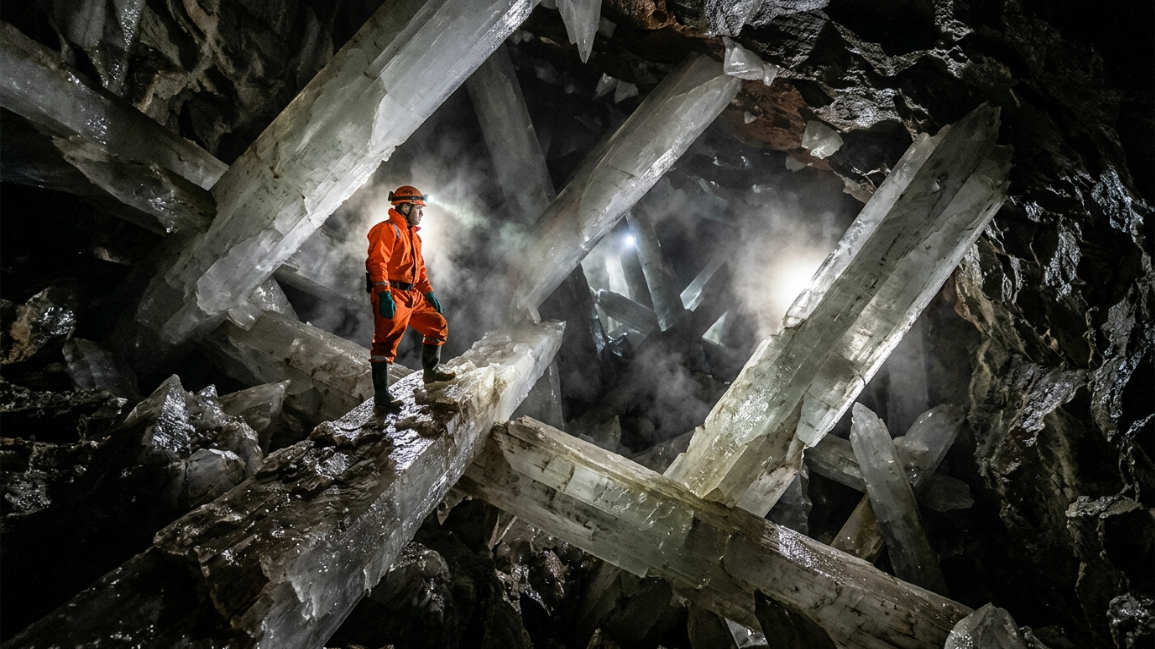
Plunging nearly 1,000 feet beneath the Chihuahuan Desert in Chihuahua, Mexico, lies one of the most physically hostile and visually stunning environmental discoveries on the planet. Discovered accidentally by mining brothers in the year 2000, the Cave of Crystals at Naica is an underground chamber housing the largest single crystalline formations ever discovered on Earth. Massive, translucent pillars of pure selenite gypsum reach lengths of up to 39 feet and weigh over 50 metric tons, crossing the steaming dark cavern like giant white beams. For years, the sheer size of these pillars drove intense public fascination. However, looking closely at the Naica Crystal Cave geology reveals a complex story of hydrothermal fluid dynamics, steady chemical precipitation, and extreme environmental balance.
What makes this underground crucible an exceptional focus for Earth science is the highly specific set of environmental conditions that allowed these massive crystals to grow. By analyzing the chemistry of the deep fault lines, the tracking of volcanic magma chambers, and the physics of mineral saturation, scientists are uncovering the exact blueprint of the Naica Crystal Cave geology matrix.
1. The Magmatic Heat Source and Hydrothermal Fluid Dynamics
The primary driver behind the unique Naica Crystal Cave geology is a massive pool of underground magma sitting roughly three miles beneath the mountain. This magmatic core keeps the lower mining tunnels at an intense, sweltering temperature.
Over millennia, groundwater from the surface trickled deep into the mountain rock, where it made contact with the superheated faults.
This contact turned the water into a rich, boiling soup packed with dissolved mineral ions, particularly calcium and sulfate. Driven by extreme underground pressures, this hydrothermal fluid was pushed upward into the deep limestone caverns. This continuous flow of hot, mineral-heavy water provided the raw building materials needed to feed the crystals, setting the stage for an incredible subterranean growth cycle.
2. The 58°C Equilibrium Threshold and Slow Growth Physics
To grow crystals to the size of telephone poles, the underground chambers had to stay at a precise, unchanging temperature for hundreds of thousands of years. This stable climate is the absolute core of the Naica Crystal Cave geology puzzle.
Laboratory tests show that the water filling the cave stayed at a constant temperature of roughly 58°C (136°F) for over 500,000 years.
[ Hydrothermal Solution Influx ]
│
▼ (Temperature Stable at Steady 58°C)
[ Slow Dissolution of Anhydrite ]
│
▼ (Continuous Saturation Wave)
[ Infinite Selenite Crystal Growth ]
At this exact temperature, a mineral called anhydrite dissolves into the water, while a softer mineral called selenite precipitates out of it. If the water temperature had dropped even a single degree lower, the chemical balance would have shattered, causing millions of tiny crystals to form instead of a few massive pillars. This stable, highly protective underground environment mirrors the perfect preservation conditions we see in the Yonaguni Monument anomaly platforms, where deep water shielded complex structures from the harsh erosion of wind and rain.
📊 Geochemical and Environmental Thermodynamic Matrix
| Diagnostic Metric | Subterranean Condition Discovered | Primary Chemical Process | Impact on the Naica Crystal Cave geology |
| Selenite Composition | Ultra-pure, translucent hydrous calcium sulfate | Sustained precipitation out of a stable mineral solution | Forms the massive, 50-ton crystal pillars across the cave |
| Ambient Temperature | Locked constantly at 58°C (136°F) for millennia | Keeps the anhydrite-to-selenite saturation point balanced | Allows massive single structures to grow instead of small clusters |
| Relative Humidity | Maintained at a suffocating 90% to 99% profile | Caused by superheated groundwater hitting sealed air pockets | Restricts human research teams without special cooling gear |
3. Continuous Saturation and Mineral Feed Mechanics
A common question surrounding the Naica Crystal Cave geology is how the crystal pillars grew so massive without developing structural flaws or structural layers. In standard surface environments, changing weather and seasonal rains cause crystals to grow unevenly, creating cloudy lines inside the stone.
Because the Naica cave was completely sealed off from the surface world inside a deep limestone pocket, it never experienced seasonal shifts.
The mineral solution stayed perfectly saturated for half a million years. This constant, uninterrupted feed allowed calcium and sulfate ions to attach to the growing crystal faces atom by atom, creating a flawless crystalline structure. This highly calculated, automated natural process mirrors the incredible care we see in human structures, like the layout choices analyzed in our Derinkuyu underground city engineering analysis, where builders relied on uniform rock properties to achieve massive structural stability.
4. Extreme Human Survival Limits and Defensive Taphonomy
The exact same environmental factors that make the Naica Crystal Cave geology a scientific wonder also make it one of the deadliest places on Earth for human exploration. The combination of a 58°C temperature and a suffocating 90% to 99% humidity level creates a deadly trap for the human body.
In this extreme environment, the air is so hot and wet that sweat cannot evaporate off your skin, meaning the body has no way to cool itself down.
If a researcher enters the cave without specialized, ice-cooled suits and heavy respirators, their lungs will instantly begin condensing water vapor, making it impossible to breathe. This extreme climate acts as a powerful layer of natural protection. It completely prevents looting, vandalism, and industrial damage, ensuring that the fragile, glass-like selenite pillars remain in pristine condition on the cave floor.
5. Industrial Dewatering and the Vulnerability of Crystal Drying
The final phase of studying the Naica Crystal Cave geology involves a stark warning about how human industry can easily damage fragile natural environments. The crystals only became visible because a local mining company pumped millions of gallons of water out of the deep mountain shafts to access nearby silver and lead veins.
While this industrial pumping allowed scientists to enter and document the cave, it also exposed the crystals to a brand-new threat: gravity.
When the cave was filled with water, the natural buoyancy of the fluid helped support the immense weight of the 50-ton pillars. Now that the cave is dry, the giant crystals are hanging in midair, causing them to slowly buckle and crack under their own immense weight. Furthermore, exposure to dry air causes the wet surfaces of the selenite to slowly dull and lose their beautiful transparency over time, showing that these underground wonders are deeply dependent on their original flooded home.
The Analytical Verdict on the Mexican Crystals
The massive pillars of Chihuahua stand as an extraordinary monument to the power of underground chemistry and deep time. As this investigation into the Naica Crystal Cave geology proves, this cavern does not require alternative history myths or supernatural answers to explain its existence.
Instead, the cave is a spectacular demonstration of natural chemistry, where superheated volcanic water, a stable 58°C temperature, and half a million years of quiet isolation allowed gypsum to grow into the largest crystals on Earth. By studying the real science of hydrothermal fluid mechanics and saturation points, modern researchers have explained how our planet can create jaw-dropping wonders deep beneath our feet. The site remains an exceptional reminder of the power of natural design, matching the incredible scale we see in other historical puzzles like the Maltese megalithic temples.
🔍 High-Authority Academic Context Verification
-
To explore the complete mineral core data and thermal scanning maps of the Chihuahua cave shafts, review the National Autonomous University of Mexico (UNAM) Institute of Geology Database.
-
For an exhaustive look at hydrothermal crystallization models and gypsum solubility thresholds, consult the International Union of Crystallography Archive.