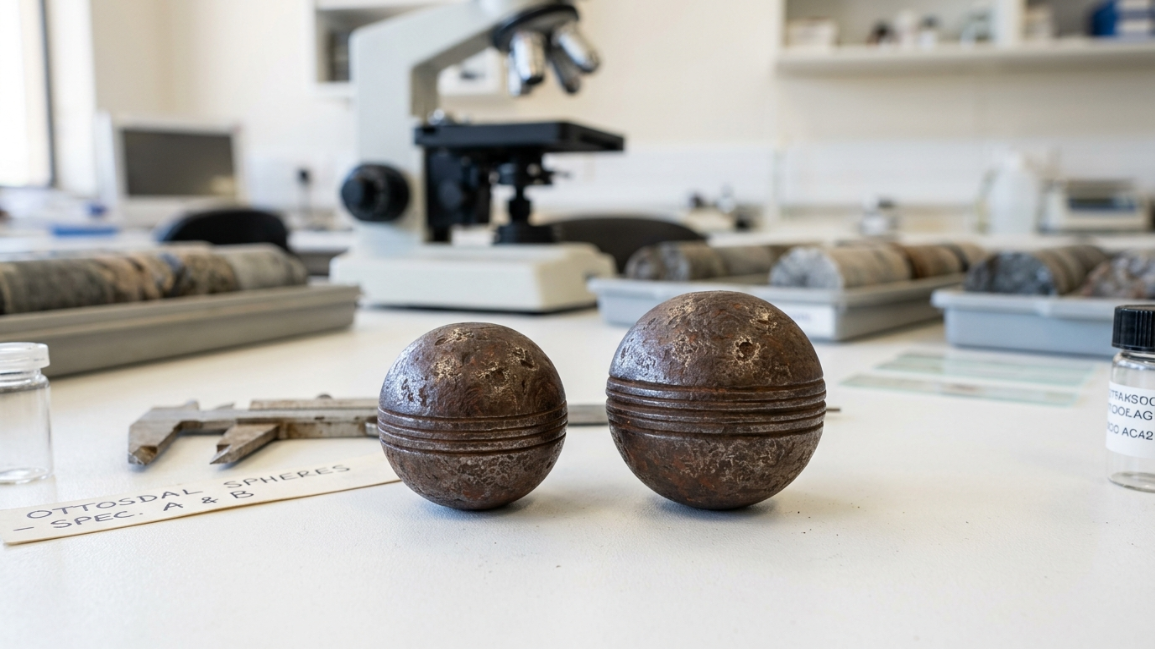
Deep within the pyrophyllite mines of Ottosdal, South Africa, industrial workers have spent decades unearthing a series of small, unusual stone objects that challenge traditional timelines. Known to researchers as the Klerksdorp spheres mystery, these dark, reddish-brown, slightly flattened disks range from less than a centimeter to ten centimeters across. What transforms these small stones into a massive archaeological debate is their highly detailed surface structure: many feature three crisp, perfectly parallel equatorial grooves wrapped around their centers like a manufactured cricket ball. Because the host rock formations have been dated to a staggering 3 billion years old, alternative history channels regularly claim these items are ancient alien tech or relics from an advanced pre-flood society. However, when the stones are removed from internet folklore and analyzed using micro-focus X-ray diffraction, the Klerksdorp spheres mystery unfolds into an incredible masterclass of planetary chemistry and metamorphic rock growth.
What makes these ancient specimens a primary focus for modern materials science is how their structured lines interact with deep geological pressures. By stepping away from sensationalized urban legends and looking closely at the physics of mineral precipitation, the grain alignment of the host rock, and the realities of mining tremors, geologists are solving the Klerksdorp spheres mystery with absolute scientific accuracy.
1. The Geochemistry of Volcanic Pyrophyllite Formations
The foundation to solving the Klerksdorp spheres mystery relies entirely on understanding the unique, multi-billion-year-old environment where they developed. The stones are not found loose in surface soil; they are completely embedded inside the Syferfontein Formation, a dense layer of ancient volcanic ash that experienced immense heat and pressure over eras.
Under these intense conditions, the soft volcanic rock transformed into a fine-grained, smooth mineral known as pyrophyllite.
Because pyrophyllite is incredibly fine-grained and porous, it functions as a highly efficient underground filter. Billions of years ago, when the earth was still in a pre-oxygen stage, mineral-rich water slowly seeped through these volcanic layers. The dissolved iron and calcium molecules began sticking to tiny grains of sand inside the rock, growing outward in a uniform, 360-degree direction to form dense mineral pods. This natural chemical crystallization process is exactly how environmental minerals gather over time, a dynamic we also explored when tracking the rapid beachrock formations of the Bimini Road anomaly in the Atlantic.
2. The Orthogonal Growth Mechanics of Fine-Grained Sediment Laminations
To the untrained eye, the crisp parallel lines cut into the centers of the stones are the ultimate proof of intelligent machining. Proponents of alternative history argue that nature cannot scratch precise, matching lines around a curved surface without tools.
However, a closer look into the Klerksdorp spheres mystery shows that these grooves are actually direct physical imprints of the surrounding rock layers.
As the mineral pods—known to geologists as concretions—slowly grew outward inside the volcanic shale, they met different layers of compressed sediment. Some of these layers consisted of incredibly fine, tightly packed carbonaceous material that was less porous than the surrounding rock. Because the water carrying the minerals could not pass through these dense layers as easily, the growth of the stone sphere was physically squeezed and restricted along that specific plane. This left behind a deep, horizontal ridge or indentation directly inside the stone body. This exact same layering phenomenon can be seen in cut specimens, where the external groove lines up perfectly with faint internal layers inside the rock.
📊 Mineral Density and Structural Diagnostic Matrix
| Material Vector | Microscopic Condition Discovered | Core Chemical Process | Impact on the Klerksdorp spheres mystery |
| Internal Nodule Core | Mixed crystalline hematite, wollastonite, and goethite | Natural mineral precipitation from ancient groundwater | Proves the objects are natural concretions, not manufactured metal |
| Equatorial Ridges | Perfect match with host rock sediment laminations | Growth restriction across low-porosity bedding planes | Disproves the theory that the lines were cut using ancient tools |
| Mineral Hardness Test | Registers strictly between 4.0 and 5.0 on the Mohs scale | Standard crystalline structure of iron oxides | Debunks the viral claim that the stones are “harder than steel |
3. The Mohs Scale Threshold vs. The “Harder Than Steel” Hoax
A highly popular claim across internet blogs is that the objects at the center of the Klerksdorp spheres mystery are composed of a mysterious, unknown alloy that is completely unscratchable and harder than modern industrial steel.
When professional laboratories conducted standard scratch tests to evaluate their mineral placement, this viral rumor was completely debunked.
Mineral assays confirmed that the stones are composed primarily of hematite, wollastonite, and pyrite—common iron and calcium minerals that form naturally in volcanic environments. On the Mohs hardness scale, where a diamond sits at a maximum of 10, the Klerksdorp stones register consistently between 4.0 and 5.0. For comparison, a standard piece of hardened pocketknife steel sits at a hardness of 5.5 to 6.5, meaning regular steel can easily scratch these stones. This discovery shows how online clickbait can heavily distort physical data, a challenge we also encountered when separating real engineering from sensationalized claims during our Antikythera mechanism mechanical engineering reconstruction analysis.
4. The Myth of Perfect Balance and Spontaneous Rotation
Another popular legend fueling the Klerksdorp spheres mystery is an unverified story claiming that NASA scientists tested one of the stones and found its internal balance so mathematically perfect that it could only have been manufactured in a zero-gravity environment.
Furthermore, museum curators in the 1980s claimed that the stones would mysteriously rotate completely on their own while locked inside sealed, vibration-free display cases.
When researchers inspected the museum display setup, the true mechanical cause was quickly found. The spheres are not perfectly balanced; many are heavily flattened, lopsided, or intergrown with neighboring stones like a cluster of soap bubbles. The reason the stones were subtly shifting inside the museum display case was due to deep, daily ground tremors caused by massive, active gold-mining operations running right underneath the town of Klerksdorp. The slight vibrations caused the round stones to naturally roll along the smooth glass shelves, creating a sensationalized story out of simple physics.
5. Global Geological Parallelism and the Moqui Marbles
The final proof that solves the Klerksdorp spheres mystery is the presence of identical stone formations discovered in completely different regions across the globe. If these items were rare alien artifacts, they would only exist in one isolated location.
Instead, geologists have mapped thousands of identical grooved spheres, most notably the Moqui Marbles found across the Navajo Sandstone deserts of Utah.
The American Moqui Marbles share the exact same chemical iron-oxide makeup, the same slightly flattened round shapes, and the same distinct equatorial ridges tracking across their centers. They form through the exact same groundwater chemistry in sandstone that the Klerksdorp variants experienced in volcanic ash millions of years prior. This global consistency proves that the shapes are a reliable, predictable product of planetary geology rather than an isolated, out-of-time mystery. This structured natural design matches the spatial design patterns we see in our Derinkuyu underground city engineering analysis, demonstrating that nature relies on consistent structural laws across all eras.
The Analytical Verdict on the South African Spheres
The unique stone spheres of South Africa stand as an extraordinary example of our planet’s ancient mineral chemistry. As this investigation into the Klerksdorp spheres mystery proves, these artifacts do not require alternative history myths or extraterrestrial interventions to explain their existence.
Instead, they are completely natural mineral concretions that crystallized inside fine-grained volcanic ash 3 billion years ago, taking on the natural parallel lines of the sediment layers as they grew. By applying standard mineralogy and debunking viral myths regarding their hardness and balance, modern science has explained these fascinating geological wonders. They remain a timeless reminder of the incredible formations our planet can create over deep time, aligning with the same natural wonder we observe in historic sites like the Maltese megalithic temples.