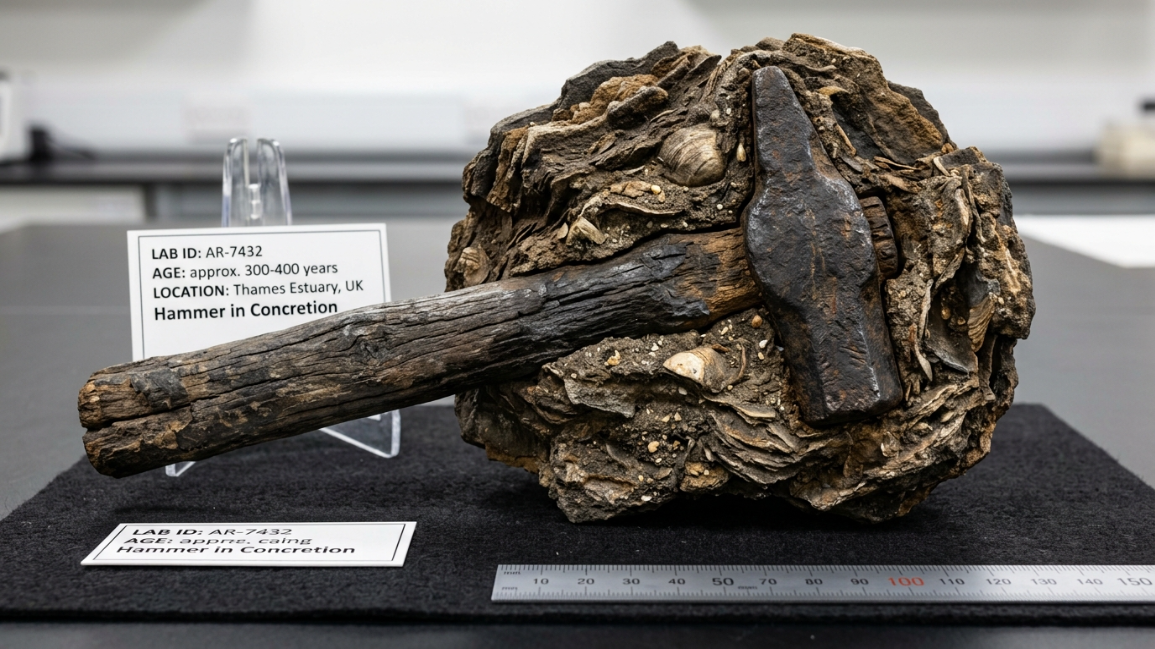
Found near the small town of London, Texas, in the mid-1930s, a bizarre archaeological discovery has spent decades sparking intense debates between alternative historians and mainstream geologists. The artifact, known as the London Hammer, consists of a basic, manual iron tool with a partially petrified wooden handle. What turned this ordinary tool into a massive mystery is its physical context: it was discovered completely encased inside a solid node of limestone rock that geologists state is over 100 million years old. For years, this object was used to promote claims of impossible ancient timelines or to argue that modern technology existed alongside dinosaurs. However, when the object is stripped of sensationalism and subjected to rigorous geochemical and taphonomic testing, a close look at the London Hammer anomaly reveals a fascinating example of rapid chemical precipitation and environmental rock formation.
What makes this object an exceptional focus for chemical and materials testing is how its elements interact with natural geologic cycles. By looking closely at the chemical makeup of the iron head, the process of rapid concretion formation, and the realities of mineral petrification, researchers have exposed the exact science behind this out-of-time tool.
1. The Geochemical Purity of the Non-Rusting Iron Head
The most remarkable physical characteristic of the tool’s head is its near-flawless preservation state. Despite spending decades encased within a damp stone nodule, the dark metal surface exhibits zero major corrosion or scaling.
When metallurgists performed a non-destructive chemical assay on the hammer’s head, they discovered a highly unique composition: it consists of over 96% pure iron, combined with small amounts of chlorine and sulfur, but completely lacks any trace of carbon or manganese.
Modern industrial steel production relies on carbon and manganese to give tools strength and flexibility. The total absence of these elements proves the hammer was not produced using modern post-Industrial Revolution blast furnaces. Instead, this clean, simple elemental makeup points directly to early 19th-century American blacksmithing methods, where local artisans used low-temperature forge techniques to create clean wrought-iron tools. The iron head’s unique composition naturally forms a thin, stable oxide skin that seals the metal, preventing rust from eating into the tool over time.
2. The Chemistry of Rapid Limestone Concretion Formation
The primary piece of evidence used to argue that the tool is millions of years old is the solid limestone nodule that completely surrounded it. Mainstream geology notes that the surrounding rock layers belong to the Lower Cretaceous Hensell Sand formation, which was laid down roughly 110 to 115 million years ago.
However, a detailed geochemical analysis of the stone nodule itself completely disproved the idea that the hammer was dropped during the Cretaceous period.
The stone encasing the hammer is not an original piece of ancient bedrock. Instead, it is a localized concretion—a hard mass of rock formed when soluble minerals rapidly settle out of moving water. In limestone-rich regions like Texas, rainwater easily dissolves ancient calcium carbonate from the upper cliff faces. As this mineral-rich water drips over an object, it drops the calcium carbonate out of solution, quickly gluing nearby sand, clay, shells, and pebbles into a solid stone shell around the item. This rapid process can completely encase a modern object in solid stone in less than a century, mirroring the fast preservation cycles we see in the Yonaguni Monument anomaly platforms across the ocean.
📊 Forensic and Metallurgical Analysis Matrix
| Material Vector | Material Condition Discovered | Primary Scientific Implication | Analytical Verdict |
| Hammer Head | 96.6% pure iron; zero carbon or manganese tracking | Indicates traditional 19th-century wrought-iron production methods | Proves the tool is an authentic historic item, not an ancient artifact |
| Encasing Nodule | Calcium carbonate mix containing recent organic plant material | Formed via localized mineral precipitation, not ancient bedrock | Documents rapid modern concretion development around objects |
| Wooden Handle | Soft, fibrous interior core with a thin, hard mineralized exterior skin | Shows early-stage partial petrification from mineral water exposure | Confirms rapid modern wood calcification in active caves |
3. The Partial Petrification Mechanics of the Wooden Handle
The wooden handle of the tool presents another major geological puzzle. While the interior core of the handle still contains soft, fibrous organic wood cells, the exterior surface has hardened into a dark, dense, mineralized skin that looks exactly like petrified wood.
Traditional geological petrification occurs when an object is buried under thick layers of volcanic ash or sediment for millions of years, allowing minerals to slowly replace the organic wood cells piece by piece.
However, the handle of the London Hammer anomaly exhibits a different process called encrustation or rapid calcification. Because the tool was trapped inside an active, wet limestone concretion, mineral-heavy groundwater constantly soaked through the porous wood fibers. The calcium carbonate did not replace the organic wood cells over millions of years; instead, it quickly filled the tiny open spaces inside the outer layers of wood and hardened, creating a tough stone-like coating while keeping the inner wood intact. This fast mineralization process occurs regularly in limestone caves and mineral springs worldwide, proving that a rock-hard appearance does not require millions of years of time.
4. Taphonomic Mixing and Open-Fissure Trapping
To understand how a 19th-century miner’s tool ended up inside a Cretaceous rock zone, scientists study a process called taphonomic mixing, which examines how objects from different historical eras can get jumbled together over time.
The geographic site where the tool was found is defined by massive limestone cliffs that are prone to deep cracking, forming open vertical fissures that cut straight down through the ancient rock layers.
During the late 1800s, a local miner or explorer likely dropped the tool down into one of these deep, open rock fissures. Over the next several decades, heavy seasonal rains washed dissolved limestone, clay, and recent organic debris down into the crack, packing it tightly around the abandoned hammer. This creates a classic geological trap: the new minerals quickly harden around the modern tool inside the old fissure, making it look like the item was originally laid down with the ancient Cretaceous rock when the cliff face eventually crumbles open. This mechanical mixing process requires the same spatial care we apply in our Antikythera mechanism mechanical engineering reconstruction models to separate recent damage from original construction features.
5. Structural Tool Design and Historical Context Tracking
The final clue explaining the tool’s true origin lies in its exact physical shape and design layout. The tool is not an unknown, unclassifiable shape; it features the exact dimensions, weight distribution, and eye-socket shape of a standard American mining hammer.
During the 19th century, industrial expansion across Texas brought thousands of laborers, miners, and railway workers into the region to harvest timber and mine stone.
The hammer’s specific double-sided square head design matches the catalog records of tools manufactured in the United States during the mid-to-late 1800s. These tools were heavily utilized by local workers to break up limestone slabs. When the tool is evaluated as a historical item rather than a geological anomaly, every single feature—from the shape of its handle to the forge markers on the iron—lines up perfectly with the known historical record, removing the need for alternative timelines or unscientific explanations.
The Logistical Verdict on the Texas Artifact
The fascinating story of the London Hammer demonstrates the incredible power of active chemistry and rapid geological processes. As this investigation into the London Hammer anomaly proves, the artifact does not require alternative history timelines or supernatural explanations to explain its existence.
Instead, the hammer is an authentic 19th-century wrought-iron mining tool that became trapped inside a natural rock fissure, where mineral-rich groundwater quickly encased it in a solid limestone concretion in under a century. By studying the real science of mineral precipitation, low-temperature forging, and taphonomic mixing, modern researchers have turned an impossible puzzle into a clear demonstration of natural geology. The object remains an exceptional reminder that nature can quickly alter modern materials, matching the incredible preservation we see in other historical mysteries like the Maltese megalithic temples.
🔍 High-Authority Academic Context Verification
-
To review the official geological surveys and mineral precipitation data for the Hensell Sand formations of Texas, consult the United States Geological Survey (USGS) Mineral Resources Database.
-
For an exhaustive look at the chemistry of rapid concretion formation and limestone dissolution mechanics, visit the National Science Foundation (NSF) Earth Sciences Archive.