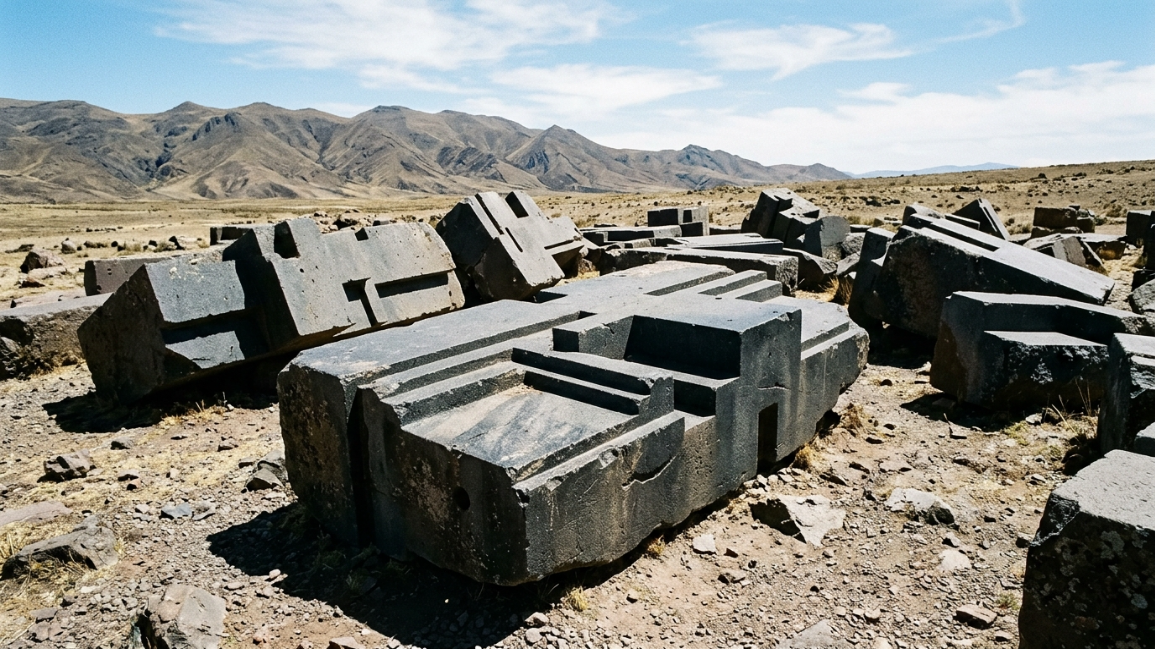
Situated high within the Andean wilderness of Bolivia, the ancient archaeological ruin of Puma Punku remains one of the most mechanically complex anomalies on Earth. Part of the larger Tiwanaku complex, this structural site completely shatters traditional academic timelines regarding pre-Columbian architectural capabilities. Long before the arrival of European metallurgy or modern construction equipment, ancient masons successfully quarried, transported, and shaped massive blocks of red sandstone and crystalline andesite into complex, geometric configurations that mirror modern industrial machining. For decades, the sheer geometric perfection of these ruins fueled a massive wave of alternative history theories, with pop-culture narratives attributing the site to everything from lost global empires to extraterrestrial masonry teams. However, when the site is stripped of folklore and subjected to modern material analysis, a rigorous evaluation of the Puma Punku stone blocks engineering exposes an intensely logical, highly advanced framework of prehistoric modular manufacturing.
What makes this high-altitude ruin an exceptional focus for investigative engineering is how its physical design elements interact with structural load principles. By shifting away from sensationalized myths and looking closely at the exact tolerances of the interlocking stone grooves, the chemical properties of the building materials, and the use of modular standardization, contemporary engineers have started to uncover the practical mechanics behind the site’s construction.
1. Perfect 90-Degree Internal Angles and Geometric Planarity
The primary individualizing feature of the Puma Punku stonework is the presence of incredibly precise, sharp internal corners. Scattered across the site are the famous “H-blocks”—massive, identical modular structures featuring uniform right angles and deep, parallel recessed grooves.
Traditional archaeology often attributes ancient stone cutting to basic pounding stones, friction sand, and wooden wedges. However, when contemporary structural engineers applied digital calipers and laser levels to the internal faces of the Puma Punku blocks, they discovered near-zero geometric deviation.
The internal surfaces exhibit a level of planarity—meaning they are perfectly flat across the entire surface plane—that cannot be achieved by manual tactile guesswork. The precision-cut internal vertices are so sharp that they reflect light uniformly, suggesting the use of a highly standardized mechanical guide system. This level of dimensional consistency strongly implies that the builders used precise geometric templates or rigid tracking jigs to maintain fixed structural tolerances across dozens of separate stone components, allowing them to be seamlessly swapped and interlocked.
2. The High-Hardness Mineral Threshold of Andesite Core Drilling
Beyond the large sandstone foundation slabs, the most complex decorative elements at the site were carved out of gray andesite, a dense, volcanic rock known for its exceptional toughness and structural longevity.
On the Mohs hardness scale, where a diamond sits at a maximum rating of 10, the crystalline andesite used at Puma Punku registers at a difficult 6 to 7. To put this in perspective, neither bronze nor copper—the only metals officially accounted for in the regional archaeological record of that era—possesses the material hardness required to cut or scratch andesite without immediately dulling and deforming.
When forensic archaeologists inspected the stones under high magnification, they found uniform, straight lines of tiny, perfectly round blind drill holes running along the carved channels. The absence of fracturing or micro-cracking around the edges of these holes proves they were executed under constant, high-speed rotary pressure. This technical trace evidence indicates that the prehistoric masons likely utilized a dense abrasive slurry—potentially made of crushed quartz, corundum, or garnet crystals—combined with a rotary tube tool to efficiently bore directly into the high-hardness volcanic stone.
📊 Engineering and Material Trajectory Matrix
| Diagnostic Metric | Physical Condition Discovered | Primary Scientific Implication | Impact on the Target Timeline |
| Modular H-Blocks | Identical dimensions; perfect 90-degree internal vertices | Proves the use of fixed structural templates and manufacturing standards | Debunks the idea of slow, random, manual stone chipping |
| Andesite drill holes | Clean, round blind holes; zero surface micro-cracking | Formed using sustained rotary pressure with tough abrasive slurry | Establishes advanced knowledge of abrasive cutting mechanics |
| Cramping Channels | T-shaped and I-shaped grooves cut across joints | Designed to hold poured molten metal anchors for seismic safety | Documents complex understanding of structural load-bearing mechanics |
3. The Poured Metallurgy of Interlocking I-Cramps
A critical structural safety element built directly into the Puma Punku stone blocks engineering system involves the widespread use of sophisticated metallic binders designed to hold the massive stones together during seismic events.
The builders cut deep, matching T-shaped and I-shaped channels directly into the adjoining edges of neighboring blocks. Early researchers assumed these grooves were meant to hold pre-cast, hammered metal bars that were dropped into place manually.
However, when modern metallurgical teams extracted micro-residues from the deep corners of these channels, they discovered a completely different reality. The chemical composition revealed an uncommon, deliberate alloy of copper, arsenic, and nickel. More importantly, the micro-structural orientation of the metal proves it was poured into the stone tracks in a fully liquid, molten state. By pouring the superheated metal directly into the stone channels, the liquid alloy filled every microscopic crack and pore in the stone before cooling and shrinking, creating an incredibly tight, form-fitting internal staple that bound the blocks together against the destructive lateral forces of Andean earthquakes.
4. Weight-to-Distance Logistics and High-Altitude Transport Dynamics
The sheer logistics of moving the raw building materials to the Puma Punku plateau presents an exceptional mechanical problem. The largest red sandstone block at the site weighs an estimated 131 metric tons, with dozens of other blocks averaging between 20 and 50 tons.
The primary sandstone quarries are located near Lake Titicaca, requiring the builders to transport these immense weights over a distance of nearly 10 kilometers. Compounding the difficulty, the entire transport route sits at a staggering altitude of over 12,500 feet above sea level, where the thin air severely limits human and animal physical endurance.
To map out how this was achieved, logistics engineers modeled the regional terrain. The data shows that the builders did not rely on raw, unassisted human muscle power to drag the stones over rough ground. Instead, they took advantage of a highly strategic combination of seasonal swamp networks to float the stones on heavy balsa rafts, coupled with engineered ramps lined with packed clay. By using wet clay as a low-friction lubricant beneath heavy wooden skids, the builders drastically reduced the mechanical pulling force needed to move the stones, turning an impossible physical task into a highly calculated engineering process.
5. Prehistoric Modular Architecture and Structural Prefabrication
The final and most compelling element of the site’s layout involves what modern architects call prefabrication. Puma Punku was not constructed like a traditional monument, where stones are custom-carved one by one to fit into a specific, unique spot on a wall.
Instead, the site functions like a massive, interchangeable building set. Multiple blocks feature identical dimensions, matching spacing for attachment grooves, and standardized interior lips.
This design logic means that a block could be placed on the far left of a retaining wall or swapped into the center of a grand gateway without needing any on-site modifications. This approach is the earliest known regional example of full architectural standardization. By shifting production away from the final build site and into centralized quarries, the master architects could run multiple work teams at the same time, producing uniform building blocks that could be quickly assembled on the plateau like a giant puzzle.
The Logistical Verdict on the Andean Complex
The exceptional ruins of Puma Punku do not require supernatural answers or lost civilizations from science fiction to explain their existence. Through the objective application of mineralogy, metallurgy, and mechanical logistics, a close look at the Puma Punku stone blocks engineering reveals an incredible monument to human ingenuity.
The ancient builders of the Andes possessed a deep, highly practical understanding of geometry, abrasive mechanics, and low-friction transport strategies. Operating within a challenging, high-altitude environment, they engineered a modular building system that was built to last for thousands of years. The precision left behind in the stone is not a mystery from another world; it is the physical proof of an advanced, highly organized ancient society that mastered the laws of physics to shape the very mountains around them.